

Sperm and Pollutants
by Vanessa Farr
with the science team, Shannen Keyser, Daniel Marcu, Morgan T. D. Davidse, Monique Bennett, Leslie Petrik and Liana Maree – from the University of the Western Cape and the University of East Anglia
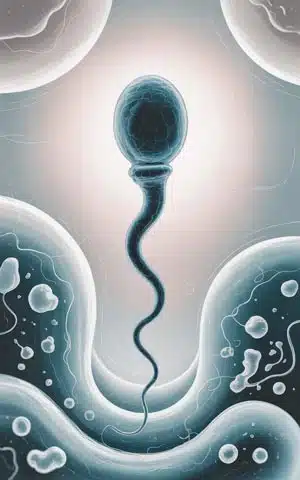 You might be wondering what sperm are doing showing up in a blog on Water Stories!
This piece is devoted to the male gamete because sperm’s function and movement are directly related to the water content and the balance of solutes in semen, the fluid that carries them. Semen is a whitish-grey, thick and sticky fluid that provides the environment for sperm. It is made from a carefully-balanced mixture of bodily fluids, water and dissolved solutes (salts, minerals, etc.) in the male reproductive tract. This liquid environment allows for movement, nutrient transport, and maintaining the internal environment of each spermatozoa cell.
Sperm’s reliance on a healthy watery environment might make them an ideal tool for testing the environmental effects of contaminants, especially those that are building up in our oceans.
With a particular concern about the health impacts of newly-synthesised substances that have become abundant in our environment, an international team of scientists based in South Africa and the UK decided to test sperm’s responses to readily-accessible human-made compounds that are known to be accumulating in coastal environments, including False Bay, near Cape Town. They worked in a controlled laboratory setting where they could test different dilutions of substances and carefully measure their effects on living sperm cells. Their conclusions were published in a leading scientific journal that focuses on toxins.
One of the questions the scientists asked was how to devise new approaches for chemical risk assessment and management of the ever-increasing number of new chemicals produced and used in commerce. The problem of these synthetic substances is sizable – and growing – because new ones are produced all the time by manufacturers in the global chemical industry, which is the world’s second largest manufacturing sector.

Over 70 000 new chemicals have been registered by these manufacturers in the past decade alone. Yet they rarely test the chemicals they produce for their effects on bodies and environments, even when the natural or synthetic compounds they produce will end up in personal care products or pharmaceuticals, where they might affect metabolism and health.
Manufacturers have also been lax about testing the environmental effects of chemicals produced for agricultural use, or industrial chemicals like flame retardants and plasticizers like Bisphenol, a chemical compound used to make plastics and resins.
Worse, they never undertake tests to figure out what might happen when the substances they produce in controlled laboratory conditions mingle with one another in the environment, potentially forming unknown new compounds with even more dangerous and unpredictable effects.
These deficits make it challenging for scientists to assess which of the substances chemical manufacturers concoct are pollutants and toxins, whether they will build up in the environment and in living bodies, and what happens when they do.
But scientists have known for thirty years that new compounds harm humans and the ecosystems we live in, and that the problem is only getting worse. This is why they describe these widely-spread but poorly understood substances as “contaminants of emerging concern” (CECs). And this is why coming up with new, easily replicable, affordable ways to understand the impacts of CECs on human health is so important.
Sperm as a Research Tool
The primary purpose of this study was to identify whether human sperm can successfully be used to learn about the effects of a variety of commonly-found CECs that are everywhere in our environment, especially in water.
Why focus on tests using human spermatozoa? Quite simply, in a healthy male, sperm are produced in great numbers: there are usually around 15 million of them in a single millilitre of semen. A semen sample is easy to collect: a male volunteer ejaculates into a container, and scientists then use the sperm as a subject for testing the effects of substances on a living organism.
An alternative might be to test these substances on non-human animals. But such testing is costly, requires numerous specimens, and is unethical. This team of scientists wanted to find a better way.
They thought sperm would provide a good mechanism to identify alternative laboratory-based testing systems for environmental risk assessment that can be replicated, are cost-effective, standardized, and reproducible, so that they can control their tests successfully and gain useful insights into chemical toxicity mechanisms in our environment.
In addition to how readily-available sperm samples are, healthy sperm are easy to identify when looked at under a microscope. They are well-formed, with an oval head that carries genetic material. In natural conception, their long tail helps sperm swim strongly and efficiently towards a fertile egg, and to navigate barriers such as the acidic vaginal environment and the narrow passageway to the fallopian tubes. But the very features that make sperm responsive to the female reproductive environment also makes them vulnerable to substances in the environment that can damage them. Previous scientific research has proven that sperm respond to various doses of environmental contaminants.
Sperm are a good subject for research on toxins because they are specialised – they only have one job, and that is to fertilise a human gamete (egg). Both their shape and their strength are crucial in achieving conception without help from doctors.
Scientists can easily assess how healthy sperm are before toxicity screening takes place. They can measure their concentration (the number of sperm in each ejaculation), motility (the energy of their movement), kinematics (the geometry of their movement, or, efficiency of their movement), mucus penetration (ability to penetrate an egg so the sperm and egg can fuse and fertilisation can take place), the sperm cell’s membrane integrity (the health and strength of the membrane surrounding the cell), and the mitochondria (which provide the cell’s energy).
These collective features convinced the research team that sperm could serve as biomarkers for contamination. A biomarker is a measurable indicator of a biological state or condition. It allows scientists to observe and measure changes in a quantifiable way, and to apply their findings in the real world. This scientific team intend their research to inform conservation efforts, especially ones focused on pollution.
What Happens When Sperm Meet Environmental Contaminants?
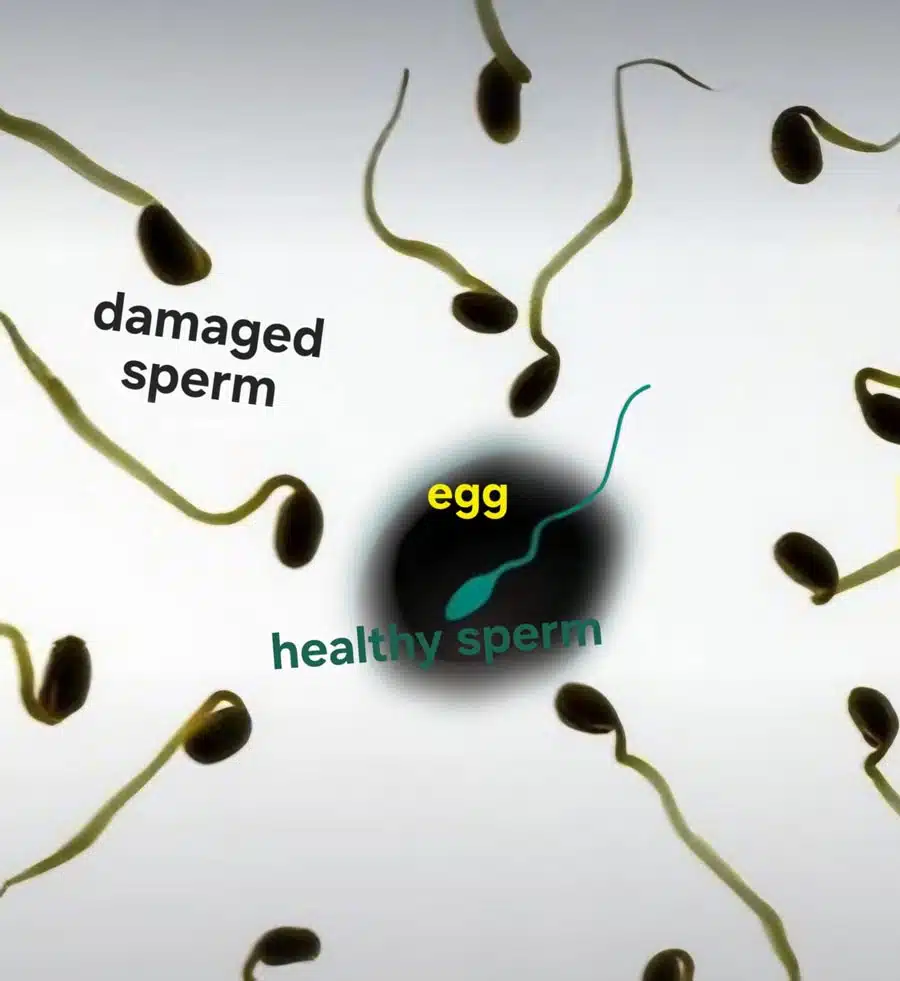 Having established why sperm are a good subject for this kind of research, the team devised laboratory tests, carefully constructing them to mimic real-world exposure levels.
Healthy sperm were exposed to five CECs (three pharmaceuticals and two pesticides) that are now found everywhere, and are highly prevalent in False Bay’s near-shore marine environment. Watching and measuring what happened after different periods of time (5, 10 and 60 minutes), and at different concentrations of the substances they were testing, the scientists were able to reveal the versatility of human sperm as a screening tool for many different environmental toxins.
The team’s intention was to determine: 1) which sperm characteristics are most sensitive, for e.g., their ability to swim 2) how much exposure most severely impacts them, and 3) how different types and quantities of contaminants affected different parts of the sperm.
First, they tested two nonsteroidal anti-inflammatory drugs, which are commonly used to reduce fever, pain and inflammation. Exposure to these drugs reduced sperm movement and speed, and damaged the mitochondria.
Next, they tested the effects of a synthetic sulfonamide antibiotic (or, “sulfa drug”) used to stop bacterial infections. Among the negative effects recorded, damage to the sperm’s tail was worst, resulting in reduced speed and ability to move energetically. Previous scientific studies have linked synthetic antibiotic use to reduced male fertility, so the team’s findings affirmed this effect.
Then the team tested for the impacts of pesticides and herbicides that are commonly used in agriculture. There are already known negative associations between exposure to toxins used in agriculture and the endocrine (hormonal) system, and there is growing awareness that the disruptive effects of herbicides are not limited to the weeds they’re intended to kill. Sure enough, in this study the sperm’s shape, swimming speed and energy of movement was significantly reduced when it was exposed to herbicide, even at very low concentrations.
An organophosphate pesticide was the fourth substance tested. While this highly-toxic class of pesticides (also known as highly-hazardous pesticides or HHPs) is intended to kill insects, they are also known to negatively impact other life forms, and especially to affect human reproduction. The team’s experiments showed the same effect: exposure to pesticide dramatically reduced the sperm’s swimming ability, membrane integrity and energy. It also killed many sperm, the equivalent of significantly reducing sperm count.
Because of their accumulated impacts and effects on each other, the scientist’s last test was to expose sperm samples to various combinations and concentrations of the substances they investigated. In every case, the sperm were damaged to the point where they would have had trouble in fertilising an egg; and in many cases, their numbers were reduced.
This is a very significant finding. Before this research, not enough was known about the effects of complex mixtures and long-term exposure to pollutants.
The cumulative results of the tests are very worrying, especially when they are contextualised within other studies that find dramatic declines in human fertility.
Every one of the toxins reduced the sperm’s speed. And, while only one of the toxins tested did not have a significantly negative impact on sperm’s ability to swim, this parameter on its own doesn’t capture the subtler effects of exposure to environmental toxins, especially when they are mixed into different compounds at various concentration levels, as the team deliberately did in their study to mimic what’s happening in the real world.
What Next?
Having established the usefulness and replicability of both their tool and their research approach, the team of scientists plans to undertake more research. Importantly for anyone worried about the possibility of permanent damage, they hope in future to examine whether people who have been exposed to toxins can recover when exposure stops. They are also hoping to work on some genetic screening tools that can be used to support future improvements in human health and disease.
Even if the results of their work are alarming, the team feels optimistic that their ground-breaking approach will be useful in both environmental and human health care.


